In fast-paced games, the inventory isn’t just a menu—it’s a survival tool. Whether you’re reorganizing your pack in Minecraft or managing attachments in PUBG, the efficiency of your “grid management” can mean the difference between victory and defeat. Our research team recently conducted a quantitative UX study to understand exactly how players interact with these grid-based systems when the heat is on. Using a custom-built top-down shooter developed in the Godot Engine, we tracked 16 participants as they battled waves of enemies while trying to maximize their “inventory value”.
Methods
The game genre was a top-down shooter with the goal being achieving the highest “bag value” at the end of the “round”. The Figure below shows the overall aspect of the enemies (triangles) and the player (circle). The focus here was inventory management, so no complex mechanics were introduced besides that to not distract the study participants. The difficulty was suited for both novice and expert players. In a single “round”, the participant must “survive” 8 waves of increasing difficulty of enemies in the game in order to complete it.

Data collection was facilitated through game-derived telemetry, which logged real-time metrics such as mouse positions, keystrokes, timestamps, and game variables like health points and coins directly from the Godot code. These telemetry logs were supplemented by a qualitative questionnaire hosted on the FramaForms platform to establish player profiles based on their age, occupation, and gaming frequency. To ensure a controlled environment, the study was conducted in a quiet setting to minimize external distractions, beginning with a brief introduction to the study and an ethics agreement before moving into a two-session format: an initial session to soften the learning curve of the mechanics and a second testing phase for actual data recording. Following the sessions, the resulting data—which remained anonymized and stored locally to comply with GDPR rules—was processed and analyzed using Python and the Pandas library to generate the study’s statistical charts.

Results
1. Pros Carry Less, But Better
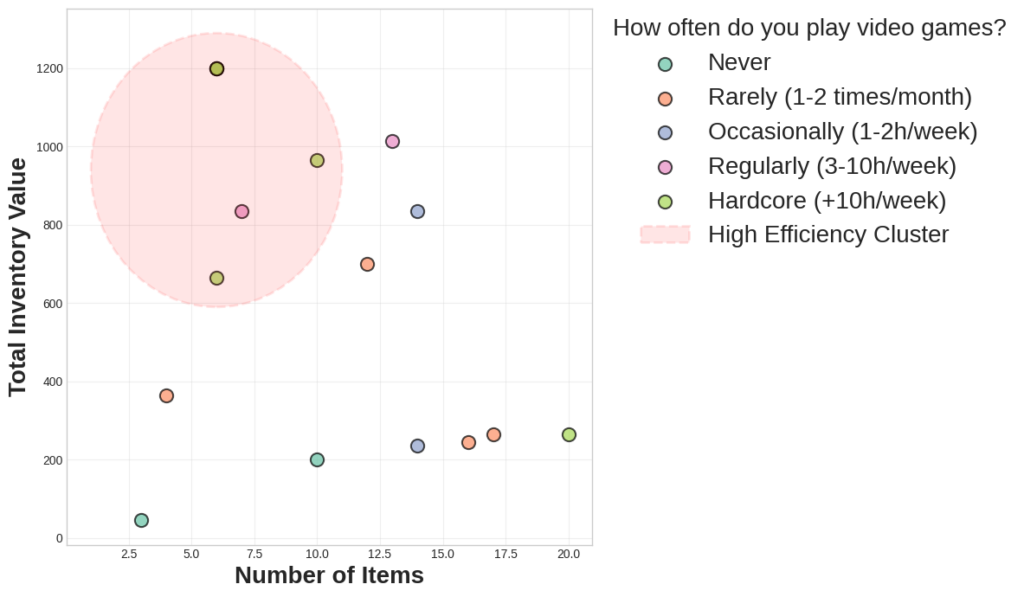
One of our primary hypotheses was that experienced players would prioritize quality over quantity. The data confirmed this: “Hardcore” players (those gaming 10+ hours a week) tended to fall into a High Efficiency Cluster. They achieved higher total inventory values while carrying fewer individual items. By mastering mechanics like aiming and movement more quickly, they freed up the “cognitive bandwidth” needed to focus on optimal item selection.
2. The Survival Paradox
We observed a fascinating “U-shaped” relationship between experience and the time spent with the inventory open. The graph below shows this curve while demonstrating that after some gaming frequency threshold (after the “Never”) players tend to spend a lot of time to familiarize with the inventory UI. However this time decreases along the gaming categories and when analysing the hardcore players we see a considerable increase.
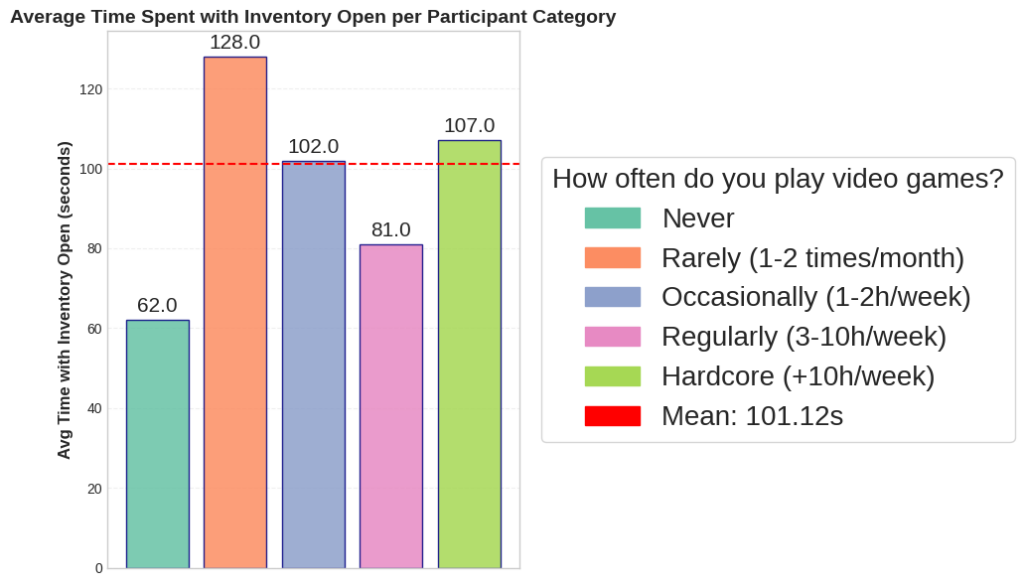
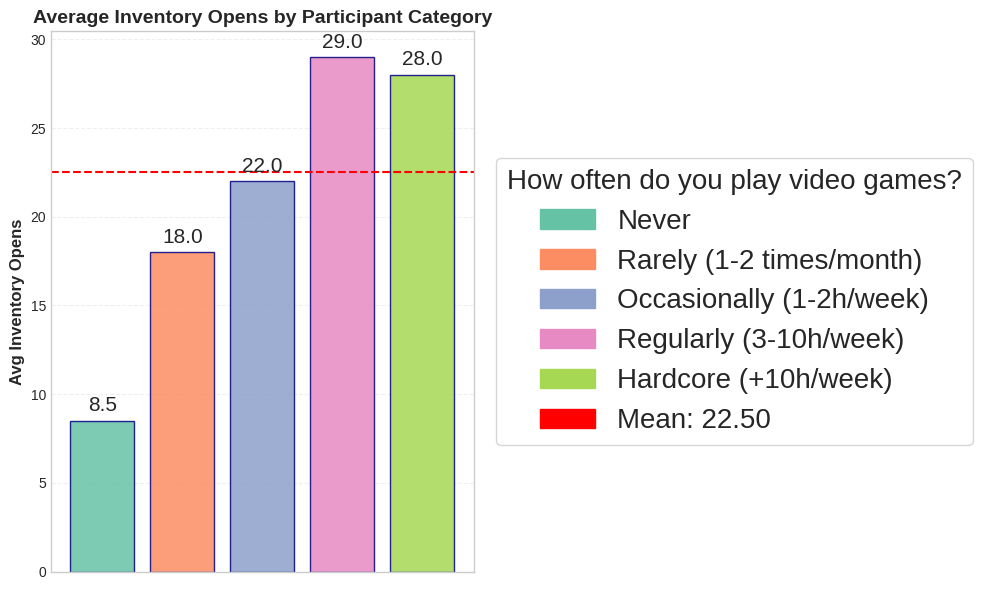
While these experts may be faster per interaction, their superior survival skills likely extended their game sessions, forcing them to access the inventory many more times in total, thereby driving up their cumulative time despite their efficiency.
This interpretation is definitively confirmed by the chart below, which shows a stark positive correlation between gaming frequency and interaction volume.
3. Corners are Mental “Bookmarks”
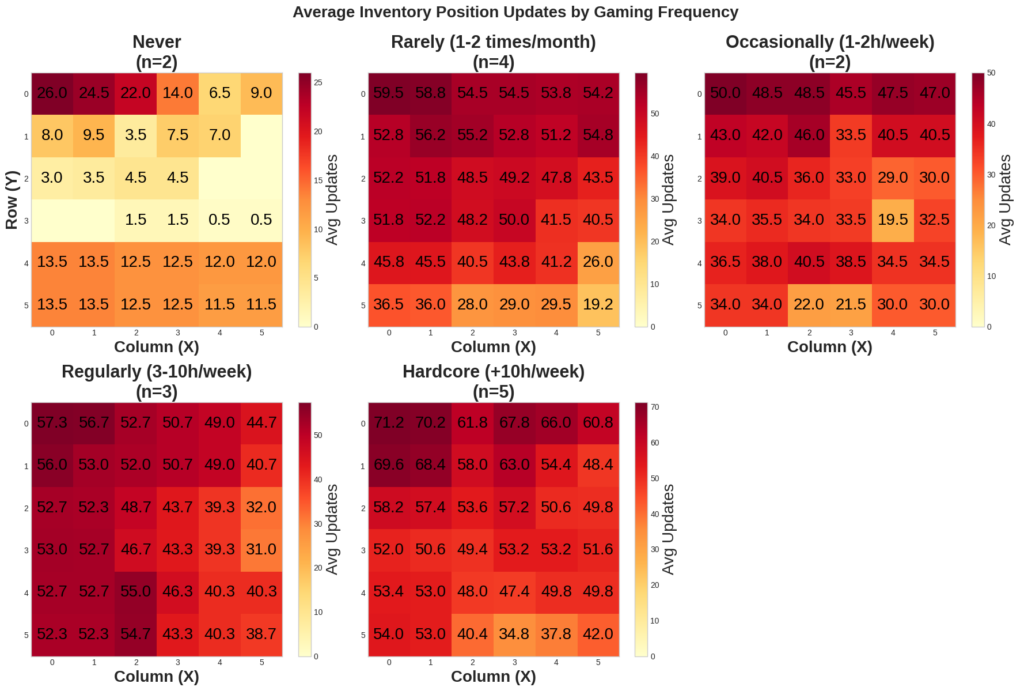
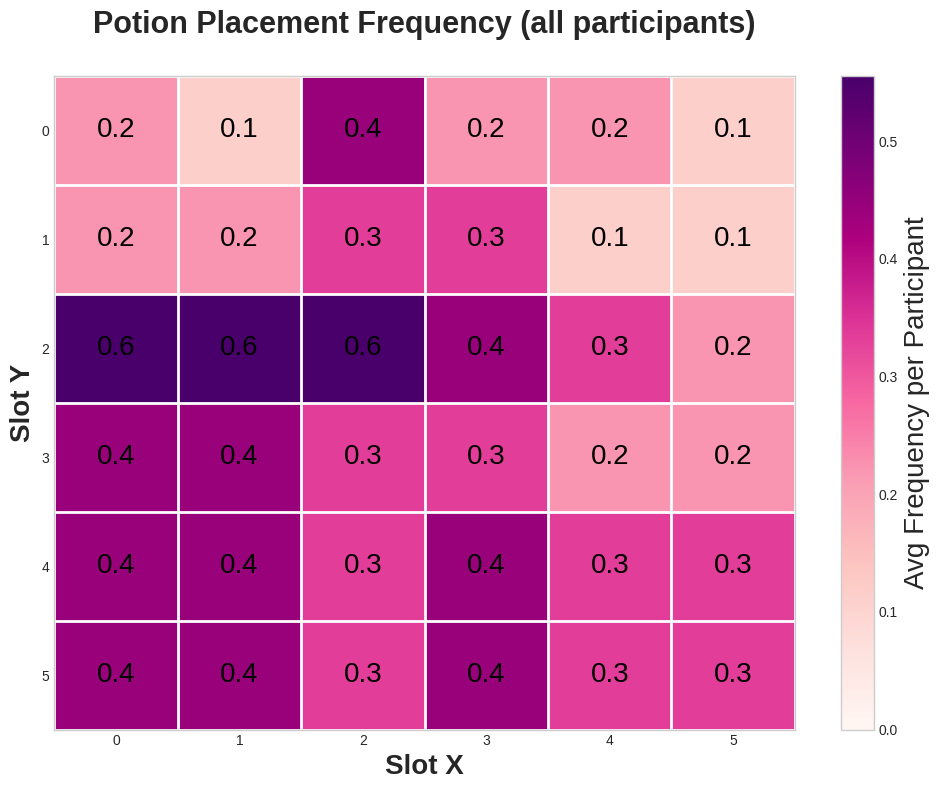
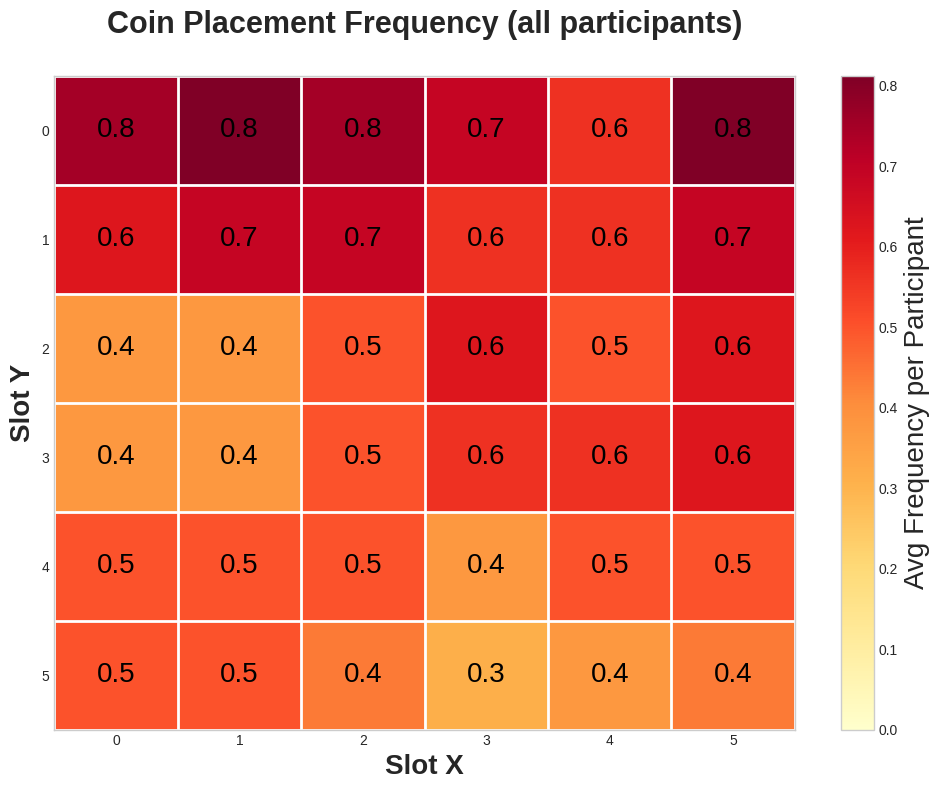
When players look at a grid, they don’t see 36 equal squares. They see a map with landmarks. Our heatmaps revealed a “compelling partial confirmation” that players favor the perimeter.
- The Top-Left is the undisputed king of slots, serving as the primary “anchor point” for the majority of participants.
- The Bottom-Right was the least used, likely due to the physical effort of moving the mouse that far across the screen.
- Experienced players used these corners as mental “bookmarks” to organize their loot, effectively reducing their cognitive load during combat.
4. Natural “Zoning” and Categorization
Even without being told to sort their items, players instinctively “zoned” the grid by item type.
- Coins were treated as default loot, typically saturating the top two rows.
- Potions were consciously segregated, with usage spiking in the middle and lower rows to keep them distinct from the “clutter” of coins.
Conclusions
In conclusion, this study successfully demonstrated how player experience and mental models directly influence interaction strategies within grid-based inventory systems. The data confirmed that experienced players exhibit superior management efficiency, prioritizing high-value items and leveraging the UI’s perimeter—specifically the top-left corner—as a spatial anchor to reduce cognitive load. Furthermore, the clear categorical segregation observed between coins and potions indicates that players instinctively impose organized “zoning” behaviors to navigate stressful gameplay. These findings provide actionable insights for game designers, highlighting the importance of perimeter zones and intuitive spatial grouping in creating user-friendly, high-performance interfaces.
Project Contributors: Alex Onceanu, Ivan Pancheniak, Mario Nnakane, Matheus Schreiber, and Mohamed Boudouh.
Tools Used: Godot (Game Dev), Python/Pandas (Data Analysis), FramaForms (Questionnaires).
Source Code: Godot Github Repository