by Naoures ABASSI, Thomas COUVERT, Sarah DAHER, Joshua MOULKAF, Raphael PADIOU and Maëlys VIEGAS
On second-hand marketplaces like Leboncoin, trust is everything. Every user, whether buying or selling, relies on cues to judge a seller’s credibility and the reliability of a listing. But which elements of interface design and content really drive that trust? Our team conducted a quantitative UX study to find out.
Why Le bon coin ?
It all started with a personal experience: one of our team members purchased Pokémon cards that turned out to be fake. This highlighted a key insight: trust doesn’t come automatically on peer-to-peer platforms it is built through visible, credible cues.
Our study focused on the trust signals users rely on.The goal was to understand how these elements influence perception and behavior, and how their design and visibility can either foster confidence or lead to suspicion.
Three Phases to Understand Trust
To understand how trust forms on Leboncoin, we designed a three-part study that looks at user behavior from different angles. In Phase 1, we observed what catches the eye when users browse naturally. In Phase 2, we tested how individual UX elements like photos, descriptions, and ratings affect trust in a controlled setting. Finally, Phase 3 examined how users make decisions under time pressure, showing which cues matter most when attention is limited.
We ran the study with 34 participants. You can take the survey here: QuantUX Leboncoin Study – it’s exactly what our participants saw!
Phase 1 – Free Scrolling
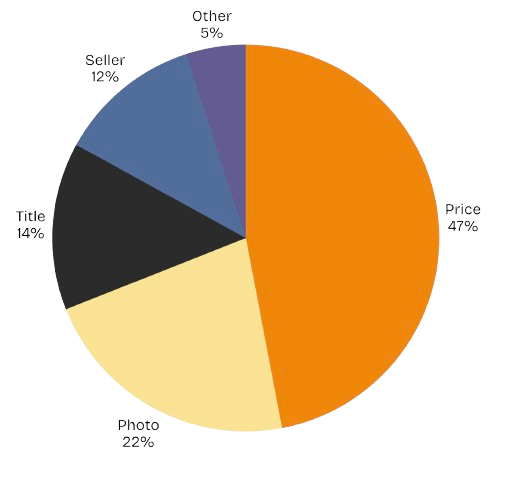
In the first phase, participants freely scrolled through real Leboncoin smartphone listings. The goal was to observe which elements users naturally rely on when deciding if a listing is worth their attention.
The results were clear: price and photos dominate first impressions. Nearly half of participants cited price as the primary factor influencing their initial interest, while photos were the next most important cue. Titles, descriptions, and seller information mattered less at first glance. This phase confirmed that trust-building begins with surface signals that are quickly and easily processed, helping users filter through large numbers of listings without overloading their attention
Phase 2 – Impact of Variables
In Phase 2, we wanted to understand how specific UX elements influence trust and engagement. We created 9 experimental listings of smartphones, each varying in elements like product photos, seller badges, ratings, descriptions, and price. Each of our participants evaluated five listings randomly selected from the set. After viewing each listing, participants rated trust in the listing, trust in the seller, and willingness to contact, and could provide comments explaining their choices.
Some clear patterns emerged:
- Photos matter but quality counts. Listings with clear, coherent images (especially contextual ones, like a hand holding the product) received higher trust. Multiple or inconsistent images, even with a professional badge, lowered confidence.
- Ratings and reviews provide reassurance. Moderate, credible ratings increased trust, while extremely high ratings or enormous volumes sometimes raised suspicion (people thought these reviews might be fake). Listings without reviews were consistently the least trusted.
- Descriptions are crucial. Detailed, transparent descriptions including condition, accessories, and defects were often more influential than having many photos. Vague or contradictory descriptions consistently reduced trust.
- Price signals plausibility. Very low prices were perceived as risky, while high prices increased perceived credibility but reduced engagement or willingness to initiate contact.
- Seller identity matters. Visible seller photos and verified badges increased confidence. The absence of a seller profile or photos caused the lowest trust scores.
- Subtle cues influence perception. Occasionally, participants noticed emotional or social cues, for example, one commented: “Rose color makes you think the seller is a female, with higher trust level.” While marginal, these cues contributed to individual variability in perception.
Across the board, participants emphasized that transparent descriptions, credible photos, and moderate ratings were the most important elements for trust. Ultimately, the study shows that trust and engagement rely on a combination of visual, textual, social, and plausibility cues, and that missing or inconsistent signals can sharply reduce confidence
Phase 3 – Attention Catching
A new constraint is introduced : time.
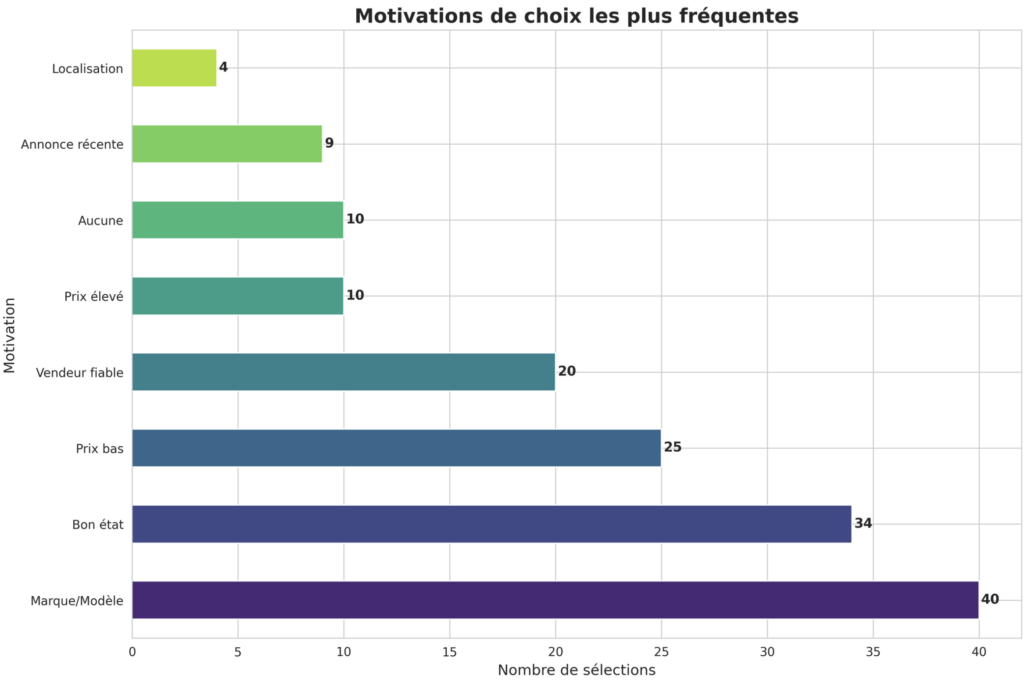
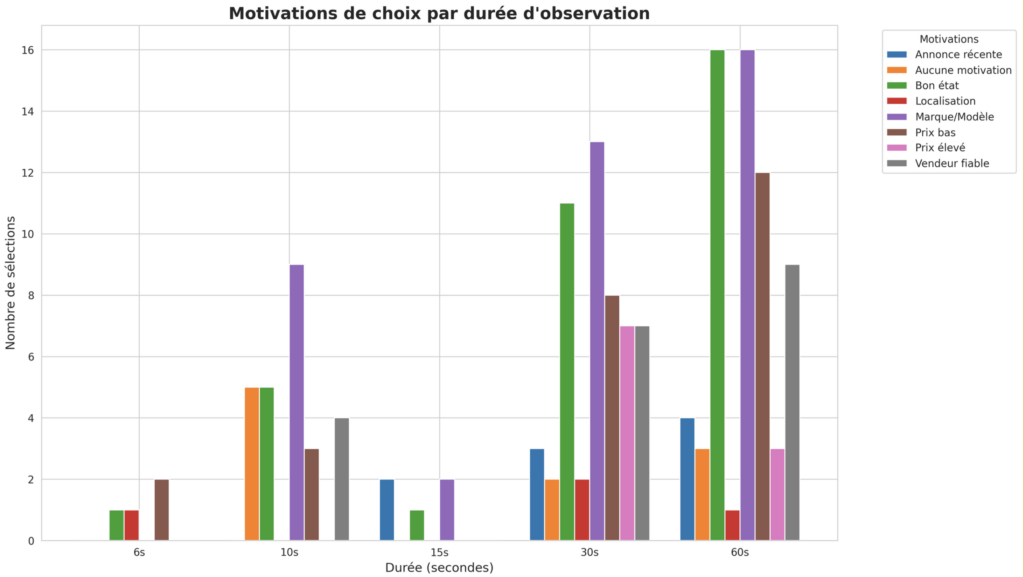
Participants were exposed to product listings for strictly limited durations 6 seconds, 15 seconds, 30 seconds, or 60 seconds. During exposure, they could not interact with the interface. This design isolated pure perceptual and cognitive processing from exploratory behavior such as clicking, zooming, or scrolling. After each exposure, participants reported which listing they would choose and explained the reasons behind their decision.
- 6 seconds: Price and brand/model dominated choices, along with large visual elements. These signals require minimal cognitive effort and are processed almost instantly. Participants frequently justified their choices with “low price” or “known brand”. At this stage, descriptions, ratings, and seller credibility were rarely mentioned. Trust was formed through fast heuristics rather than analytical reasoning.
- 15 seconds: Participants began integrating secondary attributes into their decision-making. Condition, perceived value for money, and initial seller-related cues started appearing in explanations. This phase marks a transition: users move beyond pure salience and begin assessing plausibility. They start asking whether the offer makes sense, not just whether it looks attractive.
- 30–60 seconds: Decisions became more deliberate and multi-dimensional. Participants combined several criteria at once, including photos, description quality, ratings, seller credibility, price, and condition. Rather than relying on a single dominant cue, users integrated multiple signals to build a structured and coherent judgment. Importantly, with more time, participants based their analysis on a greater number of factors even though the same core elements (price, photos, and ratings) continued to stand out. The difference was not which cues mattered, but how many of them were cognitively processed and combined into the final decision.
Summary of Results
Across the three phases, the study reveals consistent patterns about how trust is formed on Leboncoin-like marketplaces.
In Phase 1 , users were primarily attracted by visually salient elements. Price and photos immediately captured attention, confirming that first impressions are largely driven by visual prominence and simplicity.
In Phase 2, when participants had time to assess listings carefully, trust was shaped by a combination of factors. The most influential elements were:
- Coherent and realistic product photos
- Detailed and transparent descriptions
- Credible ratings and reviews
Listings with extremely low prices were perceived as suspicious, while very high prices increased perceived credibility but reduced willingness to contact. Seller identity also played a crucial role: listings without visible seller information received the lowest trust scores. Importantly, participants emphasized that detailed descriptions often mattered more than simply having many photos.
In Phase 3, the importance of elements shifted depending on exposure time. This demonstrates that trust develops progressively: immediate judgments are based on salience, while deeper trust requires cognitive processing.
Across all phases, three elements consistently emerged as dominant trust drivers: Photos, Ratings, and Descriptions.
Conclusion
This study shows that trust is built through a sequence of quick judgments followed by gradual checks. Users first react to what is immediately visible : price, photos, brand. If these elements seem plausible, they move on to deeper cues like descriptions, ratings, and seller credibility. Trust is not based on one reassuring feature, but on whether all the signals appear to tell the same story.
When elements align, the listing feels believable. When something feels off : a price that’s too low, mismatched photos, missing seller information, doubt appears quickly. Users don’t consciously analyze every detail, but they constantly look for plausibility. Trust holds as long as nothing contradicts the overall impression.
In the end, this study shows that trust in peer-to-peer marketplaces is fragile and contextual. It doesn’t come from adding more badges or more information, but from maintaining coherence between what users see, read, and expect. A listing doesn’t need to look perfect it needs to look real.
So next time you buy something online (especially Pokémon cards) take a moment to look beyond the first impression.A few extra seconds of doubt and verification can make the difference between a smooth transaction and a disappointing surprise